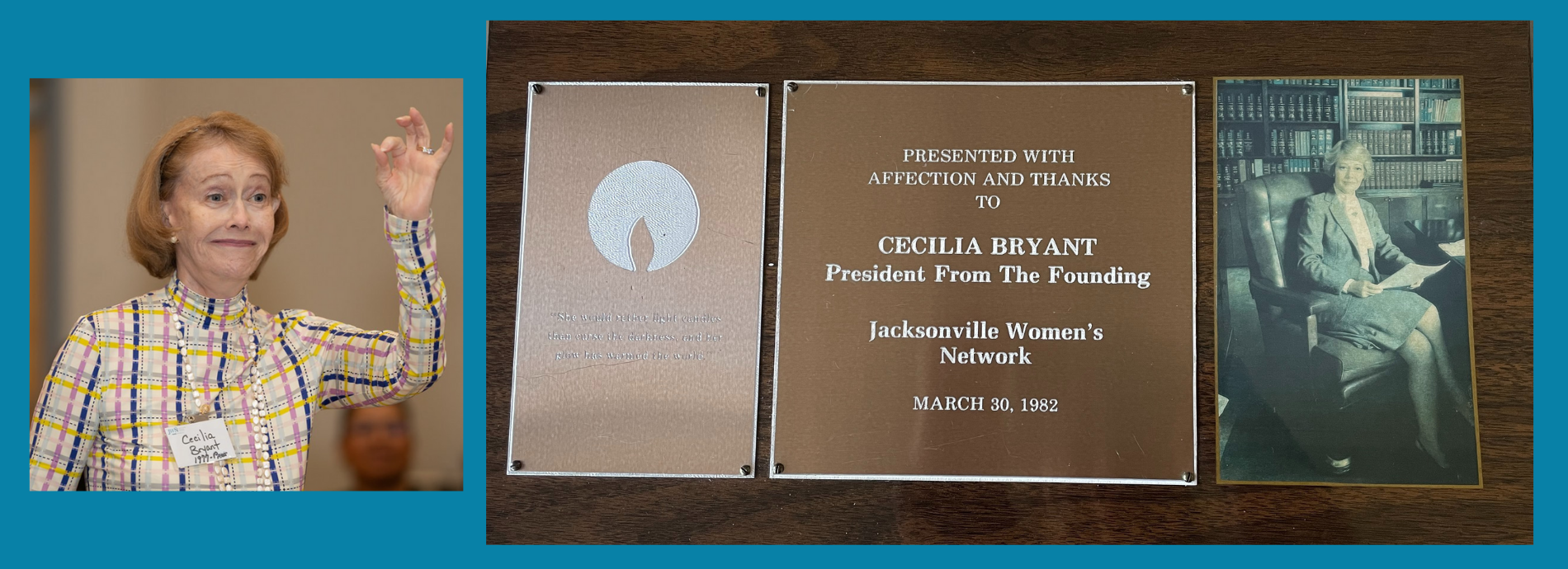
JWN founder Cecilia Bryant's personal story
If you have not yet had the opportunity to meet this legendary woman of influence, read on and learn about her path to leadership and the evolution of JWN.
"There is a saying that living well is the best revenge. I think working well is a better revenge.
Today, the first step for women is still difficult, but later steps are easier.
That is what networking has done for professional women."
—Cecilia Bryant, Founding President, Jacksonville Women's Network
In the summer of 1978, Betty Castor, then a Florida State Senator, extended invitations to Pat Ashworth, Cecilia Bryant, Roseanne Hartwell and Edna Saffy, Ph.D., to attend a meeting of The Athena Society. Its purpose was to enhance networking throughout Florida. This gathering brought together prominent Tampa women who were leaders in various fields during the 1970s, including business and politics. The event served as an opportunity for networking and discussion with the aim, in Betty Castor’s words, of bringing together women who could engage in conversations about women’s issues without causing conflict. It was at this luncheon, held at the Tower Club of Tampa, that the initial ideas for establishing the Jacksonville Women’s Network began to take shape. JWN was one of several networks that formed in the late 70’s in Florida.
Tell Us about How the Idea of JWN Took Shape.
Several of us would drive to Tampa to meet with them [The Athena Society] and plan how to expand networking to other cities. Betty Castor was not welcome at the University Club [in Tampa] which was exclusively male. Ergo, the club was unable to have the benefits of having mayoral meetings at the Club. The reality of economics forced the Club to open its doors to women. Likewise, here in Jacksonville, Tilly Fowler was unable to have City Council meetings at the University or the River Club. But, the rules changed.
I confess I whined to my father who, unbeknownst to me, was on the Board. One morning he advised me that the University Club had changed their rules and would admit women. I was stunned. I shortly got a letter from the University Club advising me that I had been nominated and that the entrance fee was $400. We are talking 55 years ago! As a young lawyer new in town, I did not have $400. I went to the bank officer who had helped me pay my way through law school (notes co-signed by my father and paid by me) and told her I needed another $400. She asked why and I told her. She smiled and smiled and gave me the $400.
Moral: women network without organizations and fathers are wonderful.
What Were The Early Days Of The JWN Like?
When I and three others founded the JWN, the first issue was to establish bylaws. We spent many hours debating the rules which would enable JWN to have a presence and build for the future. What kind of 501(c) organization were we to be? How was a Board of Directors to be chosen? We were so small that the issue of whether the President could have consecutive terms was a moot point — as I discovered for four years. How many officers to have? What was the term of years to serve on the Board? Was the Network to take political stands and if so, how were those issues to be raised and decided? (Fortunately, the decision was that the Network's mission was interpersonal, not political. We were also influenced by the fact that one of our founding members, Edna Saffy, was already the founder and president of the Florida Women's Political Caucus).
My father's Rotary Bylaws were a huge help. A major issue was whether to have Categories and what would be procedures of a Category. The idea was for a Category to control who were to be its members and what those members could or should do. At that time, there were so few women who would qualify for any category that it was almost a moot point. For many years, most categories did little except propose new members. The most active Categories were the Legal and Education categories. The most important activity of any person in the early years was communication — no Category, just action. Jean Ludlow single-handedly wrote and published quarterly newsletters and published a Membership Directory. In pre-computer days, a physical directory was the only way to quickly access the women who may be able to help other members.
The second major issue was who was to be invited to join the Network. The standard decided upon was a woman who — I think the phrase was — "stood out from amongst her peers". In order to be a Networker who could help others in their chosen fields, the members had to have succeeded themselves.
Networking is based on knowing who are the players in the chosen field and the contacts that can be accessed to help women seeking to climb the ladder of their field. When we were just an initial group of 35, all of us were in Jacksonville at a time when simply being a doctor or a lawyer was itself an achievement.
We quickly had two issues with the Categories. I got a call from Judge Susan Black who said that she could not belong to a club which discriminated! What irony! I decided on the call that she was to be the first member of the Honorary Category. No dues, no attendance — just come when able and lend us your credibility! The second issue was how to handle powerful volunteer women. While the Junior League at that time discouraged employed women from joining, it was clear to the initial members of 35 that volunteer women were already a force to be reckoned with in the community. Our great and wonderful Tilly Fowler was already a City Council Member as well as a former President of the Junior League. The group of 35 voted on the second new Category — Volunteer.
Tell Us About Your Breadth Of Influence. What Accomplishments Have Resulted From Your Influence?
In early 1982, I was at a statewide network meeting in Tallahassee. Betty Castor, [former Florida Senator and Florida Commissioner of Education], came over to me during a conference break and updated me on the retirement of J.J. Daniel from Jacksonville and the Florida Board of Regents (governing body for the State University System) due to health reasons. She asked me to make a short list of women the statewide network could recommend to Governor Graham who it was said was willing to consider a woman. I did; four names. Later she came back and asked why I had not put my name on the list. I replied [that] it had not occurred to me. She asked if she could add my name. Sure. So, she did. I asked my father what I should do. He, [being] very wise, said “Nothing. Let your friends do it.” I did, and I served on the Board of Regents for 8 years, some [of those] years with Betty Castor.
Moral: Service, Work And Friends Create Opportunity.
Once you reach a certain level of influence, the decisions you make are not determined by one issue. Simple example: while in law school at UF, women were not permitted to play tennis on university courts except at certain hours—but women paid the same activity fees. As a Regent, expressions for fair access could make quiet differences. [And, it did.] Only the powerless scream. I was Vice Chairman of the Board in my last year of civic service. I think Betty and I did well.
As a retiree, my scope of influence is small. I received my “50 Years of Law Practice” certificate last year. My challenge this year is taking an online course at FSCJ on “Introduction to Information Technology.” Learning the Canvas FSCJ operating program is so far tougher than the coursework. We have public discussions. My fellow students appear to be stunned that an elderly person is taking a computer course. So am I. There is a saying that living well is the best revenge. I think working well is a better revenge. Today, the first step for women is still difficult, but later steps are easier. That is what networking has done for professional women.
